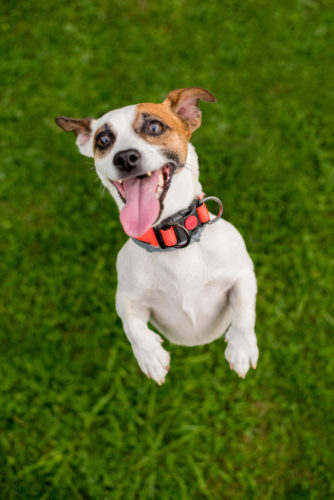
It might feel like it works… but it doesn’t solve the problem
Many dog owners have had this moment.
Your dog is barking, jumping, pulling on the lead, or ignoring you completely — and out of frustration, you raise your voice.
For a second, it works. They stop, freeze and look at you. And it feels like you’ve gotten through.
But what actually happened? You didn’t teach your dog what to do. You just made them feel something.
Yelling is an emotional reaction — not clear communication
When you yell at your dog, you’re not giving guidance.
You’re expressing emotion. Frustration, anger, stress.
And while humans understand the reason behind those emotions…
dogs don’t.
Dogs don’t interpret your intention — they experience your state.
And emotional reactions, no matter what they are, tend to feel unstable to a dog.
Whether it’s:
- Anger
- Frustration
- Anxiety
- Even guilt or sadness
These are all fluctuations in energy.
To a dog, that instability creates uncertainty — not clarity.
Why it creates short-term results (but long-term problems)
Yelling can interrupt behaviour.
But interruption is not understanding.
Your dog may stop in the moment because:
- They’re startled
- They’re unsure
- They feel pressure
But the underlying behaviour hasn’t changed.
In many cases, it actually creates new issues:
- Increased anxiety
- Reduced trust
- More reactive or unpredictable behaviour
- A dog that listens only when you escalate
So now, instead of calm influence…
you need louder and louder reactions just to be heard.
Strong, stable dogs don’t rely on emotion
If you observe dogs that naturally hold influence — the ones other dogs respond to — you’ll notice something important.
They don’t get emotional.
They don’t yell.
They don’t overreact.
They present:
- Certainty
- Clarity
- Direction
Their communication is calm, but unmistakable.
It comes through their presence, their body, and their intent — not their emotion.
That’s why other dogs respond to them.
Not because they’re loud…
but because they’re clear.
Your dog is responding to who you are being
This is where most training advice misses the point.
Your dog isn’t just responding to commands or corrections.
They are responding to:
- Your consistency
- Your presence
- Your energy
- Your level of certainty
If that changes moment to moment…
your dog has nothing stable to follow.
Yelling is often a sign that something is missing before the behaviour even happens.
So what actually works?
Real change doesn’t come from reacting louder.
It comes from becoming clearer.
The solution is not to suppress behaviour with emotion —
it’s to guide behaviour through structure and leadership.
That looks like:
1. Creating clear boundaries
Your dog needs to understand what is and isn’t acceptable — consistently.
Not sometimes. Not when you’re frustrated.
Every time.
2. Controlling the environment
Good training doesn’t rely on reacting after the fact.
It shapes situations before behaviour escalates.
Where your dog goes.
What they have access to.
When they engage with you.
This creates stability.
3. Reducing constant attention
Many dogs are overstimulated and over-engaged with their owners.
Attention becomes noise.
When everything is engagement… nothing has meaning.
4. Prioritising your experience
This is a big one — and often uncomfortable for people.
But your dog needs to feel that:
- You are grounded
- You are certain
- You are leading the direction
When your focus is constantly on managing your dog’s behaviour…
you lose that presence.
Leadership creates calm. Emotion creates noise.
Yelling doesn’t create respect.
It creates reaction.
And while reaction might look like control in the moment…
it doesn’t build the relationship your dog actually needs.
Real change happens when your dog:
- Trusts your direction
- Understands your expectations
- Feels stability in your presence
That’s where behaviour shifts — naturally.
Final thought
If you find yourself yelling at your dog, it’s not because you’ve failed.
It’s usually because no one has shown you a clearer way.
But once you understand this:
It’s not about being louder.
It’s about being clearer.
Everything starts to change.
Want help creating real change?
At SitDropStay, we don’t rely on shouting, bribes, or quick fixes.
We help you:
- Understand what’s really driving your dog’s behaviour
- Create calm, consistent leadership
- Build a relationship your dog can actually follow
No classes. No guesswork. Real results.