The Modern Dog’s Nervous System Is Under Pressure
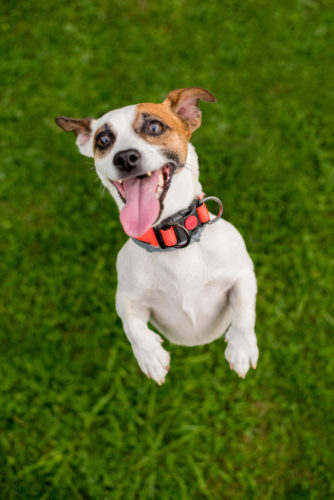
At SitDropStay, we are seeing more and more dogs being described as hyperactive, ADHD, impulsive, anxious, reactive or simply unable to switch off. Owners often tell us their dog is “constantly on,” unable to settle, demanding attention, pacing the house, overreacting on walks, struggling to relax around visitors or becoming emotionally overwhelmed by seemingly small situations. Increasingly, many of these dogs are eventually being prescribed medication.
Now to be clear, medication absolutely has its place. There are dogs genuinely suffering from severe anxiety, panic, trauma and neurological dysfunction where veterinary intervention can be extremely helpful. This article is not written to criticise veterinary professionals or suggest medication should never be used. But I do believe that in many modern dogs, something deeper is happening beneath the behaviour itself.
What we are often seeing is not simply a “bad dog,” an untrained dog or even necessarily a chemically broken dog. We are seeing a nervous system that has lost its ability to regulate naturally. And increasingly, I believe overstimulation is playing a major role in that dysregulation.
One of the greatest misconceptions in modern dog ownership is the idea that every overactive dog simply needs more stimulation, more exercise or more excitement. Sometimes this is true. Some dogs genuinely need more movement, more structure and more purposeful outlet. But many of the dogs we work with are not lacking stimulation. They are drowning in it.
From the moment they wake up, their nervous system is flooded with constant input. Busy households. Constant talking. Emotional inconsistency. Excited greetings. Noise. Screens. Visitors. Overhandling. Dog parks. Ball throwing. High-drive training systems. Treat-focused engagement. Endless stimulation disguised as enrichment. The dog’s nervous system rarely experiences genuine stillness anymore.
And eventually, the dog loses the ability to settle.
This is one of the great contradictions of modern dog culture. The more dysregulated the dog becomes, the more stimulation people often provide in an attempt to “tire the dog out.” But overstimulation does not necessarily create calmness. Very often, it creates a nervous system that becomes increasingly addicted to arousal while simultaneously becoming less capable of handling it.
Many dogs today have never truly learned how to relax internally. Not because they are stubborn or dominant, but because calmness itself has never become deeply familiar within their nervous system or relationship with the people around them. A dog can learn sit, drop, heel, recall and still be internally chaotic. This is where many training systems unintentionally miss the bigger picture. They focus heavily on mechanical obedience while accidentally reinforcing heightened states of arousal and anticipation.
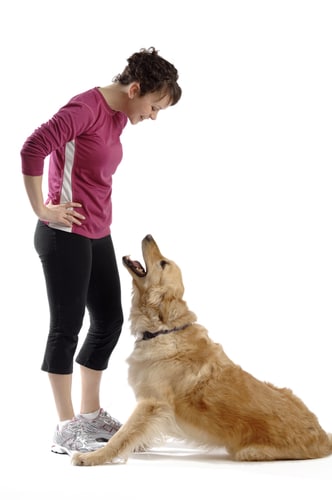
The dog learns that excitement creates rewards. Intensity creates engagement. Hyper-focus creates interaction. The dog becomes conditioned into constantly “performing” around people rather than genuinely settling around them. And eventually owners begin saying, “He just can’t relax.”
Our six dog training tips explain several everyday ways to encourage a more relaxed and cooperative attitude.
Canadian physician and trauma expert Gabor Maté has spoken extensively about ADHD in humans. His perspective is not that ADHD is simply a fixed genetic defect, but often a developmental response involving sensitivity, stress, nervous system dysregulation and environmental overwhelm. Whether one agrees with every aspect of his theory or not, the broader principle is incredibly important: the nervous system develops in relationship with the environment around it.
I believe there are strong parallels in many dogs.
Some dogs are naturally more sensitive than others. More emotionally absorbent. More environmentally aware. More reactive to tension, inconsistency, chaos and emotional pressure. These dogs often feel everything more deeply. And when they live in an overstimulating environment without enough grounding, structure, clarity, rest and calm leadership, their nervous system can become chronically activated.
The resulting behaviour may look like hyperactivity, impulsiveness, reactivity, obsessive behaviour, inability to settle, emotional volatility or constant movement. The behaviour itself is real. But the deeper issue may not necessarily be a defective dog. It may be a dysregulated nervous system desperately trying to cope with overload.
One of the hidden problems in modern dog culture is that we constantly reward excitement while unintentionally neglecting calmness. People often reward jumping with attention, demand barking with engagement, overexcitement with play, frantic energy with treats and emotional intensity with interaction. Even many popular training methods accidentally reinforce drive and excitement around the owner. The dog becomes highly stimulated within the relationship itself and eventually struggles to switch off even when nothing is happening.
A dog living in constant anticipation rarely finds peace.
Some of the most hyperactive dogs we see are not physically exhausted. They are emotionally exhausted. Their nervous system is continuously scanning, reacting, anticipating and processing without enough opportunity to decompress. This is why so many owners are shocked when their dog begins improving through things that appear incredibly simple on the surface. Better boundaries. Less chaos. Less emotional inconsistency. More structure. Calmer walks. More sleep. Reduced stimulation. Less frantic energy from the humans around them. More stillness. More grounded leadership.
The dog finally begins to feel safe enough to regulate.
Dogs are deeply sensitive animals. They absorb emotional tension extraordinarily well. An anxious household often creates an anxious dog. An overstimulated environment often creates an overstimulated dog. An emotionally inconsistent relationship often creates behavioural inconsistency. This does not mean owners are “bad.” Modern life itself has become highly dysregulating. Fast. Busy. Loud. Emotionally overwhelming. And many dogs are struggling under that pressure, particularly sensitive dogs.
Again, medication absolutely has its place in some cases. But before immediately assuming the dog is chemically deficient, perhaps we should first ask better questions. Has this dog truly learned how to settle? Does this dog experience enough genuine rest? Are we constantly rewarding arousal? Is the environment overstimulating? Does the dog have calm structure and boundaries? Is the owner emotionally grounded and clear? Does the dog actually feel safe?
Because many dogs today are not lacking stimulation.
They are lacking nervous system relief.
At SitDropStay, we believe unwanted behaviour is often the dog’s solution to internal stress, confusion or dysregulation. That is why true behaviour change rarely begins with obedience alone. It begins by helping the dog return to balance. Calmness. Clarity. Safety. Connection.
Because a regulated dog does not need to fight the world nearly as hard.
And often, neither does the owner.
If your dog struggles to settle, becomes reactive, overexcited or emotionally overwhelmed, our Dog Behaviour Training programs focus on understanding the deeper causes of behaviour — not simply suppressing symptoms. We have expert trainers in Adelaide, Cairns, Sunshine Coast, Brisbane, Gold Coast, Central Coast and Melbourne.