Most people contact a dog behaviour professional because they want something about their dog to change.
They want the barking to stop. The pulling to improve. The reactivity to disappear. They want their dog to stop jumping, demanding, ignoring, controlling interactions or becoming completely overwhelmed in certain situations.
That makes perfect sense.
But sometimes there is another part of the picture that is worth exploring, and it has nothing to do with blaming the owner for the dog’s behaviour.
It is simply this:
What happens inside you when your dog does the thing you desperately want them to stop doing?
When a behaviour acquires emotional charge
There is a big difference between calmly noticing an unwanted behaviour and being triggered by it.
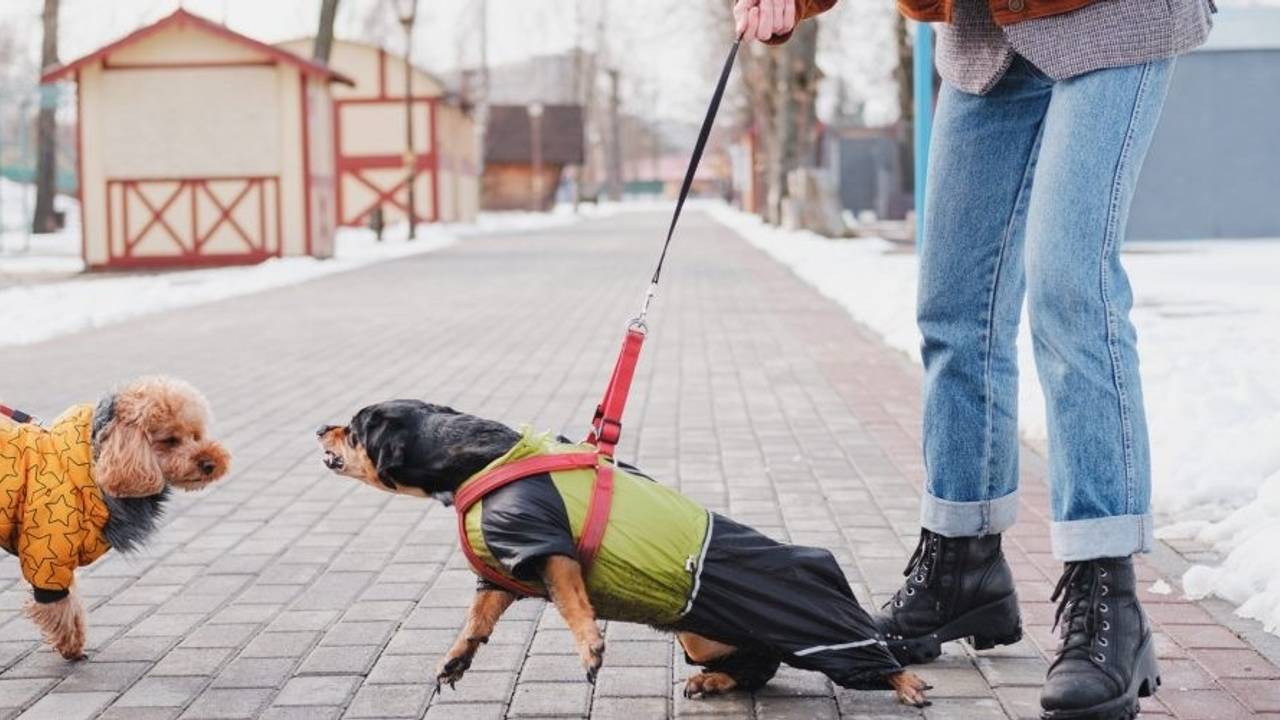
Perhaps your dog barking at another dog makes you immediately anxious because you’re worried about what will happen next. Maybe their refusal to respond makes you angry because it feels as though they’re ignoring you. Perhaps jumping on visitors leaves you embarrassed and imagining that everyone thinks you have an uncontrollable dog.
After enough repetitions, we can begin reacting before the behaviour has even happened.
We see the approaching dog and shorten the lead. We hear the car in the driveway and brace ourselves for chaos. We notice the dog’s expression change and think, Here we go again.
The dog hasn’t necessarily done anything yet, but we have already entered the old pattern.
The feedback loop
Dogs are extraordinarily responsive to what happens around them. Our movement, tension, timing, attention and reactions all become information.
That doesn’t mean your anxiety “caused” your dog’s reactivity or that every behavioural problem is somehow a reflection of an unresolved issue in the owner. Dogs are dogs. Genetics, learning history, environment, health, temperament and previous experiences all matter.
But once a pattern exists between a dog and a human, both individuals can begin contributing to its continuation.
The dog behaves. The human responds. The dog responds to that response. The human responds again.
Eventually the interaction can become remarkably predictable.
And that is actually good news, because if you can recognise your part of a pattern, you have somewhere new to create change.
What meaning have you attached to the behaviour?
This is where the question becomes more interesting.
If your dog ignores a request and you feel disproportionately angry, what does “being ignored” mean to you?
If your dog behaves badly in public and you feel intensely embarrassed, whose judgement are you worried about?
If uncertainty around your dog’s behaviour makes you desperately try to control every situation, what does not being in control feel like?
There is no predetermined answer.
Sometimes there isn’t a deeper answer at all. You may simply be tired of your dog barking!
But occasionally a dog’s behaviour touches a pattern that exists elsewhere in our lives.
Perhaps we struggle when people don’t listen to us. Perhaps we are very sensitive to being judged. Maybe uncertainty makes us anxious, so we try to control outcomes. Maybe we feel responsible for keeping everybody around us happy.
Your dog didn’t create those patterns.
They may simply provide an unusually honest place to notice them.
Changing your side of the conversation
Once you notice the emotional charge, you have options.
Instead of automatically reacting, you can become curious.
Can I give different feedback here?
Can I remain clear without becoming angry?
Can I interrupt this behaviour without making it an emotional battle?
Can I tolerate this moment without immediately needing to control it?
That doesn’t mean abandoning training or boundaries. Quite the opposite. A calmer human response can make our communication clearer because we’re responding deliberately rather than emotionally.
Sometimes the dog changes quickly. Sometimes they don’t.
But either way, something important has changed: the behaviour no longer controls your internal state in quite the same way.
And perhaps this is one of the unexpected gifts of living with dogs.
They don’t only give us opportunities to teach.
Sometimes they give us opportunities to notice ourselves.
Better You. Better Dog.